|
Introduction
Alantus/EDP is composed of two integrated pieces, the Alantus Visual Builder(AVB), and the Alantus Application Server. Utilizing these two pieces of Alantus allows developers to deliver enterprise applications on almost any hardware available today. The combination of these two elements form the product that we call Alantus/EDP, or simply Alantus. Alantus allows companies to get applications to market fast. Even an unoptimized application may be tested and used operationally.
Alantus Visual Builder
Simply Stated : With Alantus, you craft one coherent message based entirely on world wide standards, and deliver that message through Corporate Brochures, Multimedia CDROMS, or Web Sites.
This is possible for the following reasons
- Web Architechure - Alantus adheres to a true 3 tier Client server Model
- Alantus Architechure - Alantus is designed to support component based design from the ground up. Component design is based on the following principles
- High Speed Components do the work, and are built by the highest priced developers on the market. This means that components are built in C++ or Java as ActiveX Controls or JavaBeans.
- Our goal is simple, contract/buy/build the objects that we need to run the business logic, and reuse the components over and over again on different projects. Alantus supplies a set of very useful Beans to use.
- Utilize a higher level language to glue the high speed components together, and select a language that is well known, fast, will run on any server, and is also reuseable. The only language that meets that criteria today is Javascript (ECMA Script).
- Event Driven Design - While Alantus supports stateless design, the true power of Alantus comes from it's event driven design. All Windows, Browsers and Macintosh Applications are based on events, i.e. an event occurs on the screen (a mouse click), and something will happen. This is what Alantus Delivers, with the difference that these events occur across the network. For example, a developer may build an application that continually looks for the best price on a product from the company database based on a set of criteria. This application could run on the server, and notify the client at some later date of the product comparison by delivering an event.
- Client Side Page Caching - Alantus is capable of caching pages for high speed access. It is possible to develop a Web site that navigates as fast as any native application on any machine.
- Client Side Javascript API - This API removes compensates for the differences between Netscape Navigator and Internet Explorer.
- Alantus Visual Builder - The AVB is where the productivity begins.
- With 6 built in editors - Video, Text, Graphics, Audio, Interface, and a Javascript Editor.
- Visual Interface Builder - Visually build Multimedia, Web pages(HTML 3.2/4.0), Database Query By Example(QBE) forms, XML Documents bound to XSL, and more.
- Visual Script Language for Multimedia
- Plug-in DLL's
- AVB is an Active X Control to plug into MS Office products, and Visual Basic.
- The Multimedia Database, Text Engine, and the Graphics Engine are ActiveX Controls.
- Content Management through the Multimedia Database, and full text search and retrieval.
- XML Compression - Alantus compresses the XML data being transmitted, which results in speed increases for large data sets. The compression may be turned on or off, however the default compression mode is on.
Key Competitive Advantages of Alantus
Alantus provides unique exclusive advantages to corporations building web-based enterprise applications. The competitive advantages reside in three major areas
- Development
- Deployment
- Totally Integrated Content Management
DEVELOPMENT ADVANTAGES
- Ease of development - ERAD
Alantus Visual Builder represents a major business competitive advantage. The mere fact of having a Multimedia Authoring tool, an HTLM Authoring tool, 6 Information/Media Editors, Full Text Search and Retrieval, and Content Management in one tool, makes this development environment unique. Couple these benefits with a visual drag and drop interface, development automation of connection to databases, Query by example, and Visual Complex Query development, the bar has been raised to new levels of productivity. This increased productivity delivers cost savings through component reuse, rapid application development, and reduced TCO. The result is that companies complete more projects per fixed set of programmers.
- Choice of language, tools, and platforms.
Alantus provides developers with choice and flexibility. Applications can be written in the language of the developer's choice, including Java, JavaScript, or C/C++. Developers may also leverage existing expertise by using Alantus together with their preferred HTML authoring tools, editors, compilers, Graphics Programs, Web Servers and other tools. The Alantus application server works with many platforms including Unix, Linux and Windows NT.
- Code reusability.
Alantus uses JavaScript on both the client and server as a glue language. JavaScript in turn runs all of the other programs developed for a user application as components, this is the first level of reuse. The second level of reuse is the ability to reuse JavaScript code fragments.
DEPLOYMENT ADVANTAGES
- Request and transaction management.
Alantus has full database transactional support, and can successfully handle a high volume of incoming requests. With high level state and session management capabilities, Alantus supports multistep, complex requests for transaction-based operations, database resource management, auto-commits, rollback on queries, commits on success, and rollback on failures. Alantus also supports JDBC for a consistent view of heterogeneous databases.
Scalability. Alantus Scales to deliver a system as big as your hardware will take you. Some of the sections below will show a diagram of how this is accomplished
- Extensibility.
Alantus has a modular architecture and support for server and application modules that are dynamically loadable. This allows corporations to easily extend their applications quickly and effectively. Through the installation of new modules that provide additional functionality, applications can continue to be enhanced with minimal system downtime.
- Robustness.
Alantus operates on a component-based architecture and connection pooling. Application logic can be reconfigured and added or removed without system downtime. This superior robustness is provided by the nature of the Alantus and Web Architecture.
With this powerful environment there are many types of enterprise applications developers may build.
1. Publish Corporate information on CDROM
- Reference Material - Archiving Documents
- Implement High quality training content
2. Generate and Publish Marketing Material and Communications from your databases
- Generate/Publish Documents for Print Purposes
- DataSheets
- Mass Mailing
- Mass HTML documents
- Corporate Reports
- Monthly Reports
- Specifications
- Generate/Publish Documents for Web Delivery
- DataSheets
- Mass Mailing
- Mass HTML documents
- Corporate Reports
- Monthly Reports
- Specifications
- All of the above, and more in HTML, RTF, and PDF
3. Build eCommerce, ERP applications, or standard Internet sites with ease
- eCommerce Applications
- ERP Applications
- Standard Web Sites, static or dynamic
4. Multiple Levels of Reuse
- Code Level Reuse
- Content Level Reuse
- Video, Text, Audio, Graphics and Animations
- Design Level Reuse
- Reuse different design techniques
- Knowledge Management Reuse
The Alantus Architechure
Where does Alantus fit in the Enterprise
Alantus can either reside either in the middle tier of the enterprise, or Java, C/C++, and component based clients may connect directly. Simply, any device capable of sending ASCII XML, may communicate with the Alantus Application Server. Once the client is connected, commands, events, and access to enterprise resources may be transacted.
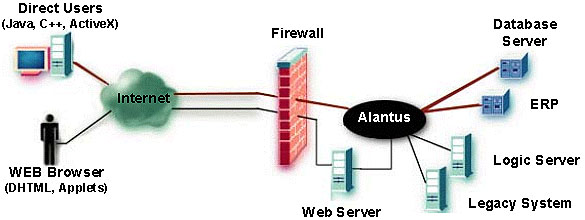
Figure x - Alantus in the Enterprise
With the above configuration, Alantus can deliver the following services
- Hosts and processes application/business logic written in Java, JavaScript or C/C++
- Execute logic written in 4GL/VB or any component model JavaBeans or COM
- Manages high volumes of transactions with back-end databases and deliver connection pooling
- Deliver scalable high performance, rapid deployment of transactional applications, our ERAD capability
- Has an open and extensible architecture that is fully compliant with all existing web standards, including HTTP, HTML, CGI, TCP/IP, JavaScript(ECMA) and Java
- Works with all popular web servers, browsers, and databases
The Overall Alantus Architechure
This section will focus on the applications that are built with the visual builder, and connected to the Applications server. The diagram below shows an overview of the Alantus architechure. The client in this case is a browser, and the browser is programmed through a combination of Java and JavaScript to deliver information that is transmitted via XML to the server. The server interprepts the XML, processes the commands, extracts the data, peforms some data access and transmits the result back to the client using XML.
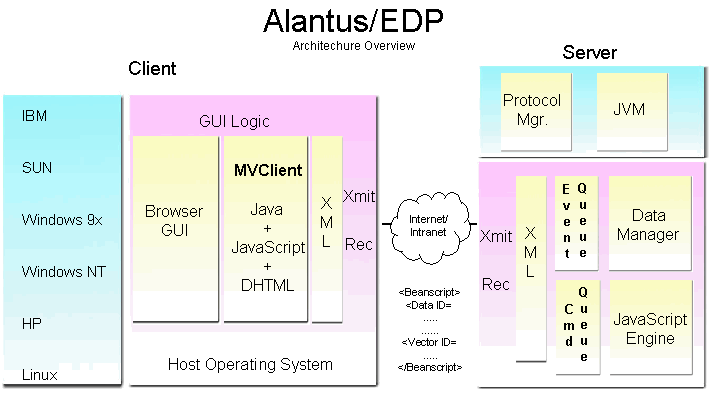
Figure 1 - Alantus/EDP Architechure Overview
What are the standards, and goals for this design?
- Portable Code
– Super Glue 1: JAVA - To achieve this goal we must be able to run our code on any server. That means that the glue that binds our main infrastructure must be Java. However Java is not capable of doing the whole job, and there are other languages (C, C++) that must be included, and other object models to consider. These other components must be callable from the main environment, thereby deliver our server independence.
- Portable Data
– Super Glue 2: XML – To deliver data to any machine, utilizing any object model, and any language, we require a data transportation format that is capable of representing data as objects. That capability is delivered by XML, originally developed by IBM, gives us the ability to talk as easily to Win32 Clients as to Browsers, essentially delivering our Client independence.
- Tools to delivery Productivity
– To deliver on the promise of this technology requires a set of tools to deliver the productivity that is implied in this model. The Alantus Visual Builder delivers this capability.
- Event Driven Applications
: A full event driven application development platform that delivers all of the required capabilities for enterprise development.
- Connection Pooling.
The major components of Alantus
- The Authoring tool will generate browser based or Win32 based Client Applications directly. The diagram above shows the client sitting on top of the operating system, sending and receiving XML from the Alantus Application Server.
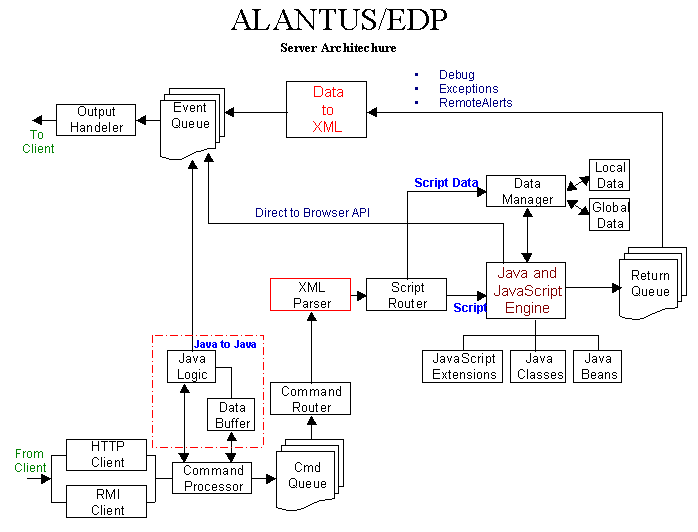
- The Server component of the system manages the events, commands, local and global data.
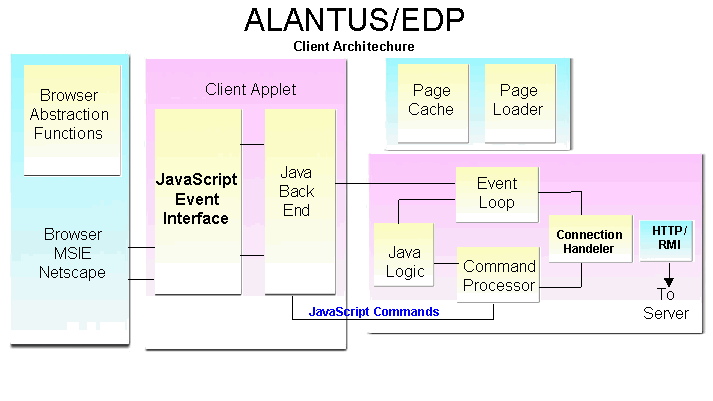
Detailed Client Diagram:
Detailed Server Diagram:
|